
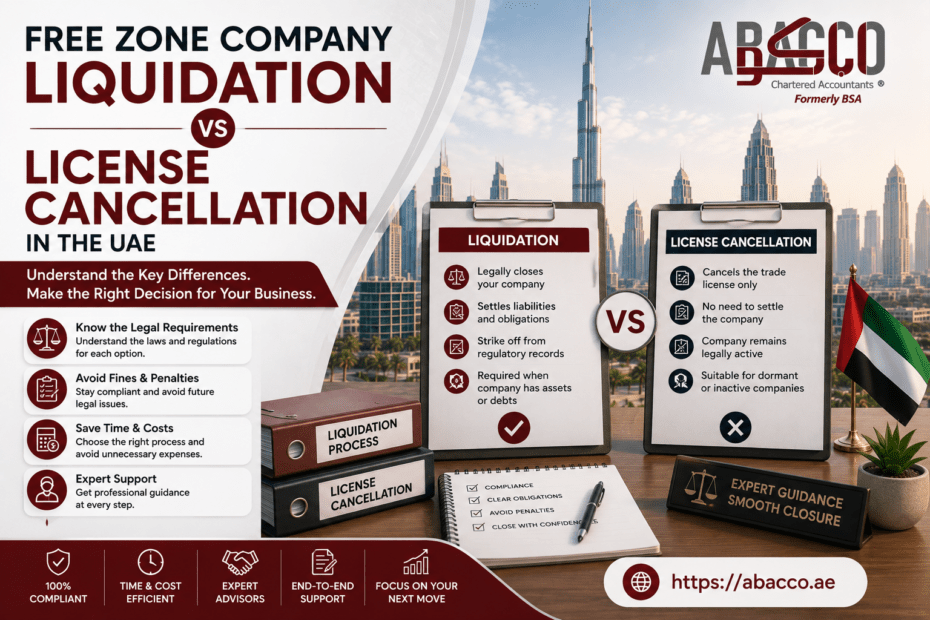
We get this question constantly from business owners winding things down, and it trips people up more than it should. Someone tells them “you need to liquidate,” someone else says “just cancel the license,” and now they genuinely don’t know if those are the same thing. They’re not. And picking the wrong one, or assuming one automatically covers the other, can leave you with an unresolved legal entity sitting on record long after you thought the business was closed.
Let me actually walk you through this properly.
The Short Version
License cancellation is a narrow, administrative step. Liquidation is the full legal process of winding up a company. Here’s the thing most people miss. In most active free zone companies, license cancellation isn’t an alternative to liquidation at all. It’s a step inside liquidation. Once you get that relationship, the rest of this makes a lot more sense.
What Cancelling a License Actually Does
Cancelling your trade license ends your permission to operate under it with your free zone authority. That’s genuinely it. It stops the business activity and stops the renewal fees piling up.
But here’s what it doesn’t do, and this is where people get caught out. It doesn’t dissolve the company as a legal entity. It doesn’t settle any debts you owe. It doesn’t cancel visas your company sponsored. And it doesn’t close your bank account or release you from obligations the company still holds as a legal person.
Which is exactly why cancelling the license alone almost never actually closes anything for a company that genuinely traded. Had employees? Had debts? Had a bank account? Cancellation leaves every one of those threads hanging, and hanging threads have a way of showing up again when you least expect it.
What Liquidation Actually Means
Liquidation is the real, full process. Formal, legally defined, and thorough. For a free zone company it generally means appointing a licensed liquidator, getting shareholders to pass a resolution to wind up, publishing a public notice that gives creditors a window to come forward with claims, clearing any outstanding debts, cancelling every visa tied to the company, closing the bank accounts, and getting clearance certificates before the company is finally struck off.
License cancellation happens near the end of all that. Not instead of it.
So When Does Simple Cancellation Actually Work?
There genuinely are cases where you don’t need the full circus. This applies to companies that basically never got off the ground. No operations. No liabilities of any kind. Never opened a bank account. Never sponsored a single visa. No contracts hanging out there with a supplier.
That’s a company that exists on paper and nowhere else. If that’s truly your situation, several free zones do allow a simpler cancellation route, skipping the full liquidation machinery. But I’ll be honest with you here, because I see this mistake constantly. People assume they qualify for this shortcut when they don’t. Even a barely-active company usually has something. One visa that got issued. A dormant bank account nobody closed. An invoice from a supplier that never quite got settled. Any one of those things and you’re back to needing the full process, whether you like it or not.
Why This Distinction Actually Matters
Get it wrong and there are real consequences. Cancel the license on a company that still had genuine debts or an open bank account, and none of that quietly vanishes. The company can sit there on the record, still racking up fines, still triggering compliance flags, while you’re walking around thinking it’s closed. Banks especially don’t just let this slide. An account tied to a company that stops operating without a formal wind-down can get frozen, or flagged, sometimes without much warning.
This is the exact trap I’ve seen catch people out, sometimes years later. They find out their “closed” company still has an outstanding fine, or an unresolved status with the free zone, because cancelling the license felt like crossing the finish line when it genuinely wasn’t.
Figuring Out Which One Your Company Needs
Here’s a decent way to think it through. Never really traded, zero debts, no bank account, no visas ever issued? A simplified cancellation might genuinely fit, though I’d still confirm that directly with your specific free zone rather than assuming. Ever operated at all, held an account, sponsored a visa, signed a contract, owed anyone money? You need the full liquidation. Doesn’t matter how small the business was or how briefly it ran.
If you’re not sure which camp you’re in, lean toward liquidation. Finding out later that your “cancelled” company still has loose obligations is a much more expensive, much more stressful problem than just doing it properly the first time round.
What Full Liquidation Actually Looks Like
For the businesses that do need the whole process, it tends to follow the same basic shape. Shareholders pass a resolution to liquidate. A licensed liquidator gets appointed to run things. A public notice goes out, usually giving creditors around 45 days to raise any claim. Outstanding debts and employee settlements get cleared in that window. Clearance certificates come through from the relevant authorities. Visas get cancelled. Bank accounts get closed properly. And finally, the license itself gets cancelled and the company gets struck off the register, with a liquidation certificate confirming it’s genuinely, finally done.
Questions I Get Asked Constantly
Can’t I just cancel the license instead of doing the whole liquidation thing?
Only if the company never operated, has zero liabilities, no bank account, and no visas out there. Any of those present, and you need full liquidation to actually close it properly.
What if I cancel the license and the company still owes money?
That debt doesn’t just go away. The entity can stay on record, keep attracting fines, and you could end up with a much messier problem to sort out later.
How long does liquidation actually take?
Roughly one to three months in most cases. That 45-day creditor notice period is the fixed floor, so you can’t move faster than that regardless of how well organized you are.
Do I need a liquidator just to cancel a license?
If the company was genuinely inactive with nothing to settle, some free zones will let you skip the liquidator. If the company operated in any real sense, you need one as part of the proper liquidation process.
Making Sure You’ve Actually Closed the Door
The real difference between liquidation and simple license cancellation comes down to one question. Does your company genuinely have nothing left to resolve, or is there still something real sitting there, a debt, a bank account, a visa, that needs proper handling? Get that answer right at the start and you save yourself from discovering a mess months or years down the line.
At Abacco, we handle both license cancellation and full liquidation for free zone companies across the UAE, and we start every case by actually working out which one your business genuinely needs rather than guessing. If you’re planning to close your company, get in touch with our team and we’ll give you a straight answer on what your specific situation actually requires.