
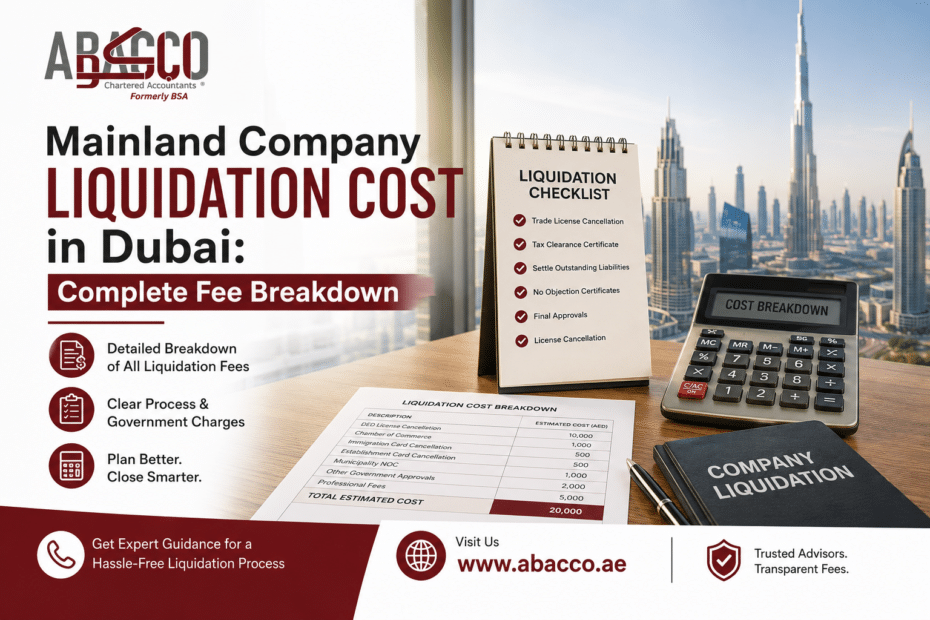
Mainland Company Liquidation Cost in Dubai: Complete Fee Breakdown
Closing a company is rarely a decision anyone makes lightly, and once you’ve made it, the last thing you want is confusion about what it’s actually going to cost you. Mainland company liquidation in Dubai isn’t as simple as just stopping operations and walking away — there’s a formal legal process, several government fees, and a handful of steps that, if missed, can leave you liable for penalties on a business you thought you’d already closed.
This guide breaks down exactly what drives the cost of mainland company liquidation in Dubai, what the process actually involves, and what to expect in terms of timeline — so you can go in with realistic expectations rather than a nasty surprise halfway through.
Why Liquidation Costs Vary So Much
There’s no single flat fee for mainland company liquidation, and anyone who quotes you one figure before understanding your business hasn’t actually scoped the job. The cost depends on several factors that genuinely change the amount of work involved.
The size and complexity of your company matters enormously — a small consultancy with no employees and simple accounts closes very differently from a trading company with inventory, multiple bank accounts, outstanding contracts, and staff to settle. Outstanding liabilities play a big role too. If your company has debts, unpaid supplier invoices, or unresolved legal matters, these all need to be addressed before liquidation can be finalized, and that adds both time and cost. The number of licenses and government approvals attached to your company also affects the fee, since certain business activities require additional regulatory clearances before a trade license can be cancelled. And whether you use a liquidator or handle parts of the process yourself shifts the balance between professional fees and your own time.
Given how much these factors vary, the honest answer to “how much does it cost” is: get a proper quote based on your specific company, rather than relying on a generic number that doesn’t reflect your actual situation.
What Actually Makes Up the Cost
Even though the total varies, the components of mainland company liquidation cost are fairly consistent across most cases. Here’s what you’re typically paying for.
Liquidator appointment fees. Dubai mainland companies are legally required to appoint a licensed liquidator to oversee the winding-up process. This is a mandatory professional fee, and it’s usually one of the larger single costs in the process.
Government and Department of Economy and Tourism (DET) fees. These cover the formal deregistration of your trade license and company records with the relevant Dubai authority.
Newspaper publication fees. UAE law requires a public liquidation notice to be published in local newspapers — typically in both Arabic and English — giving creditors a window to raise any claims against the company. This is a fixed, unavoidable cost.
Clearance certificate fees. Before liquidation can be finalized, you’ll typically need clearance certificates from various authorities confirming there are no outstanding obligations — this can include immigration, labor, utilities, and in some cases the Federal Tax Authority.
Visa cancellation costs. If your company sponsored employee or investor visas, each one needs to be formally cancelled, which carries its own government fees.
Bank account closure and any outstanding liabilities. Settling final balances, closing corporate bank accounts, and resolving any debts or dues all factor into your total cost before the process can be completed.
The Mainland Company Liquidation Process, Step by Step
Understanding the process helps explain where the costs actually come from.
Step 1 — Shareholder resolution. The company’s shareholders or board formally pass a resolution to liquidate the company, which typically needs to be notarized.
Step 2 — Appoint a licensed liquidator. A registered liquidator is appointed to oversee the process, verify the company’s financial position, and manage the formal winding-up.
Step 3 — Publish the liquidation notice. A public notice is published in local newspapers, giving creditors a set period — typically 45 days — to file any claims against the company.
Step 4 — Settle outstanding liabilities. Any debts, dues, employee settlements, and outstanding obligations are cleared during this period.
Step 5 — Obtain clearance certificates. Clearances are obtained from relevant authorities confirming the company has no outstanding obligations — this can include tax, labor, immigration, and utility providers depending on your business.
Step 6 — Cancel visas. Any employee or investor visas sponsored by the company are formally cancelled.
Step 7 — Final deregistration. Once all clearances are in place and the creditor notice period has passed without unresolved claims, the liquidator submits final documentation to the Department of Economy and Tourism to formally deregister the trade license.
Step 8 — Liquidation certificate issued. Once everything is confirmed complete, a final liquidation certificate is issued, officially closing the company.
Documents Required for Company Liquidation
Getting your documentation together early speeds up the entire process considerably. Typically required documents include the original trade license and company registration documents, the shareholder resolution to liquidate, passport copies of shareholders and authorized signatories, the Memorandum and Articles of Association, financial statements and outstanding liability records, employee records for any staff requiring settlement, and bank account statements and closure confirmation.
Companies with disorganized records tend to face significantly longer liquidation timelines, simply because gathering missing documentation after the fact takes time that a well-organized company wouldn’t lose.
Company Liquidation Timeline in Dubai
Realistically, the full liquidation process for a mainland company typically takes anywhere from one to three months, though this varies based on your company’s complexity and how quickly outstanding matters are resolved.
The mandatory 45-day creditor notice period is usually the fixed floor — you can’t finalize liquidation faster than that window allows, regardless of how organized you are. Beyond that, the speed largely depends on how quickly outstanding liabilities are settled, how many clearance certificates are needed, and how promptly documentation is submitted at each stage. Companies with clean records, no outstanding debts, and no employee visas tend to move through the process considerably faster than those with unresolved obligations.
Common Mistakes That Increase Liquidation Costs
A few avoidable mistakes tend to drive costs up unnecessarily. Delaying the decision while liabilities continue to accrue only increases what needs to be settled before liquidation can proceed. Incomplete documentation causes delays that extend professional fees over a longer engagement. Unresolved employee matters — unpaid dues, uncancelled visas — can hold up the entire process and trigger penalties. And attempting to skip required clearances to save time almost always backfires, since missing clearances simply block final deregistration until they’re obtained anyway.
The businesses that liquidate most efficiently are the ones that address outstanding matters early and work with a liquidator who manages the whole process end to end, rather than trying to handle pieces of it independently.
Common Questions
How much does mainland company liquidation cost in Dubai?
It varies significantly based on company size, outstanding liabilities, number of licenses, and visas involved. Rather than a fixed figure, it’s best to get a quote based on your specific company’s situation.
How long does mainland company liquidation take?
Typically one to three months, with the mandatory 45-day creditor notice period forming the minimum timeline regardless of how organized your documentation is.
Do I need a liquidator to close a mainland company in Dubai?
Yes. Appointing a licensed liquidator is a legal requirement for winding up a mainland company in Dubai.
What happens if my company has outstanding debts when I want to liquidate?
Outstanding debts and liabilities must be settled as part of the liquidation process before final deregistration can be completed. This is often the main factor extending both cost and timeline.
Getting Your Liquidation Handled Properly
Closing a mainland company in Dubai involves more moving parts than most business owners expect, and the cost genuinely depends on your specific situation rather than a one-size-fits-all figure. Getting organized early, settling outstanding matters promptly, and working with an experienced liquidator are the biggest factors in keeping both cost and timeline under control.
At Abacoo, we manage mainland company liquidation from start to finish — handling the liquidator appointment, government coordination, clearances, and final deregistration so the process is as smooth as possible. If you’re considering closing your company, get in touch with our team for a clear breakdown of what your specific liquidation will involve.